YOUR EQUITY IS SHOWING
What the banks know about your home, why they keep calling, and how to think clearly before you pick up.
If you have owned your home for more than a few years, something has shifted in your mailbox. The pizza coupons thinned out. The catalogs stopped. But a new stack appeared: glossy mailers from banks and lenders reminding you about the money sitting inside your walls.
Then came the calls. “You have equity. You have options. You have an opportunity. Call us today.”
They are not wrong. You probably do have equity. And there are real situations where tapping it makes sense. But before you call back, it is worth understanding how this product works, who it works well for, and who tends to walk away having paid more than they planned. The short answer, before we get into the math:
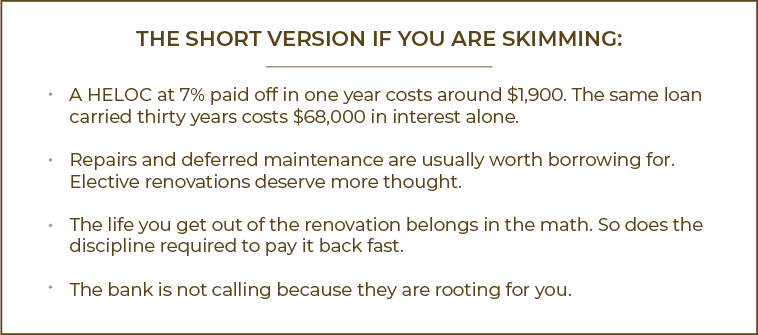
If something is broken and causing damage, borrowing against your equity to fix it is usually the right call. The cost of waiting compounds. But how quickly you pay it back matters more than almost anything else in this decision.
If you want to renovate a home you plan to live in for years, the math is more interesting than the banks let on. The life you get out of it belongs in the calculation. If you are stretching to make the numbers work, the numbers are telling you something.
This is the aporia of the equity decision. There is real evidence on both sides. Solid reasons to borrow, solid reasons not to — and the honest answer depends on which evidence actually applies to your situation.
WHAT IS A HELOC AND HOW DOES IT ACTUALLY WORK
A HELOC, or Home Equity Line of Credit, is a second loan on top of your existing mortgage. The bank looks at how much your home is worth, subtracts what you still owe, and offers you a portion of that difference as a revolving line of credit. Draw from it as needed, pay it back, draw again. A home equity loan works similarly but gives you a lump sum upfront at a fixed rate instead of a flexible line. Both use your home as collateral. Right now the national average HELOC rate is around 7.2 percent. Home equity loans are running about 7.4 percent. Those are averages for borrowers with strong credit and significant equity. Your number will depend on your credit score, your existing debt, and how much of your available equity you are tapping. One thing worth knowing before you fall in love with an offer: some lenders lead with introductory rates that expire in six to twelve months. After that, the real variable rate takes over. Read what comes after the asterisk.
$@%! Is right!
Like casinos, there are not a lot of banks closing down because they couldn’t make money.
WHAT DOES A HELOC ACTUALLY COST OVER TIME
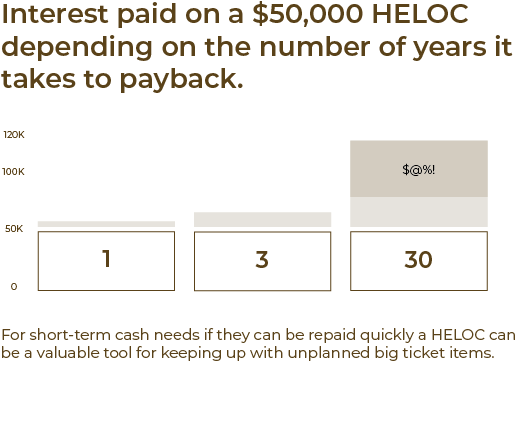
The monthly payment during the draw period often sounds manageable. Borrow fifty thousand dollars at 7.25 percent and your interest-only payment is around three hundred dollars a month. That number is what the mailer wants you to remember. Here is what that same loan looks like depending on how quickly you pay it back.
The real cost of $50,000 at 7.25%:
Pay it off in 1 year: ~$1,900 in interest | Total paid back: $51,900
Pay it off in 3 years: ~$5,600 in interest | Total paid back: $55,600
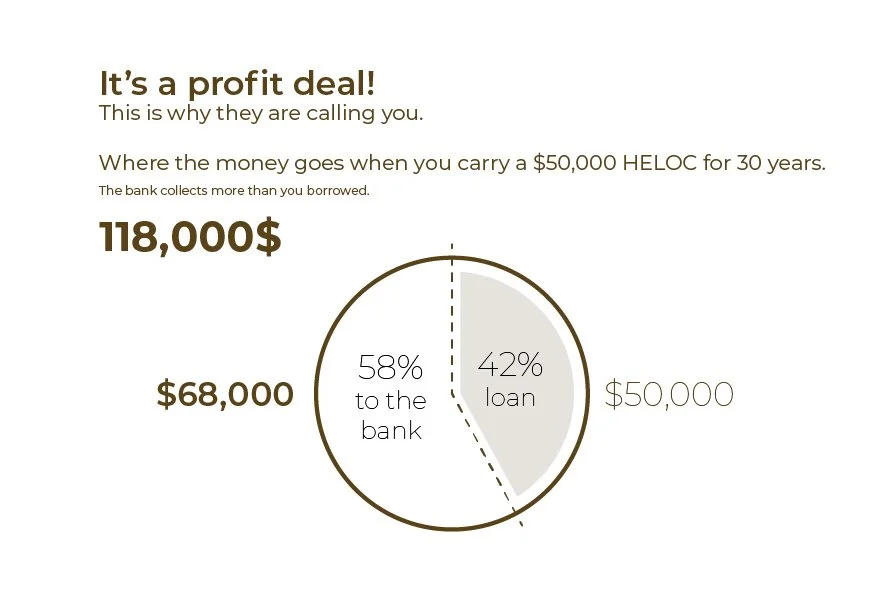
Carry it the full 30 years: ~$68,000 in interest | Total paid back: $118,000
That gap is not an accident. The draw period with interest-only payments is not a courtesy. It is a mechanism. Minimum payments feel manageable while the clock runs. By the time repayment kicks in at year eleven, the balance has not moved at all. The bank designed the product knowing most people who intend to pay it off quickly do not. Life gets in the way. The line stays open. A decade later nobody remembers what it was for.
WHEN DOES IT MAKE SENSE TO BORROW AGAINST YOUR HOME EQUITY
Not every situation is the same. The math points in different directions depending on what the money is actually for. If something is broken and getting worse, stop reading and call a contractor. A leaking roof does not stay a leaking roof. It becomes water damage, ruined insulation, drywall replacement, and mold remediation. Deferred maintenance compounds faster than interest. Borrowing to stop active damage is almost always the right call. The same logic applies to a failing HVAC, an aging electrical panel, or a foundation that needs attention. These are not upgrades. They are the cost of ownership that got postponed. For necessary repairs, a HELOC at 7 percent is also significantly better than the alternatives most people reach for. Contractor financing is often 12 to 18 percent, sometimes with deferred interest that backdates if you have not paid the full balance by the promotional deadline. Credit cards are worse. If the roof needs replacing now, a HELOC or home equity loan is usually the smartest way to finance it. If you go this route, treat it like a contractor bill. Pick a payoff date (twelve to twenty-four months is the target) and hit it.
Here is why that matters. If you borrow $50,000 and carry it for the remaining life of your mortgage, you will pay back $118,000 total. You borrowed fifty thousand dollars and the bank collected sixty-eight thousand dollars in interest on top of it. That is what a manageable monthly payment actually costs when you stop paying attention. The bank is hoping you forget that number exists. Where it gets more interesting is the renovation that is more want than need. The kitchen. The primary bath. The deck that has been on the list for five years. Those deserve a different conversation, and a different kind of math.
WHAT SELLERS ALMOST ALWAYS SAY AFTER THE RENOVATION
Here is a pattern I have seen more times than I can count. A seller decides to list. We walk the house together and talk about what will help it show well. Paint the living room. Replace the carpet. Update the light fixtures. Add the backsplash they never got around to. Most of it is not expensive. Some of it takes a weekend. We do the work. The house looks great. And then, almost every time, the same thing happens. The seller walks through the finished house and says some version of: why didn't we do this sooner. We would have actually enjoyed living here like this. The upgrades they made for a stranger were the upgrades they had wanted all along. They just never made the time or found the money until there was a deadline and a commission attached. That is not a criticism. It is a very human thing. But it is worth sitting with before you decide that now is not the right time to fix what you have been living around for years.
IS A HOME RENOVATION WORTH IT IF YOU ARE GOING TO LIVE THERE FOR YEARS
Here is the part the banks never mention. A lot of people carry a list. The kitchen that needs updating. The bathroom that has looked the same since 2003. The backyard that could be so much more. The list does not go away. It waits. The renovation conversation often has very little to do with return on investment and quite a lot to do with daily quality of life. Sometimes the kitchen is not just a kitchen. It is the thing one person has wanted for a decade and the other has been slow to prioritize. That conversation is often quietly happening inside the HELOC conversation, even when nobody says so out loud. Run the honest numbers. But run all of them.
The math the spreadsheet won't show you:
Kitchen renovation cost: $40,000
Years enjoyed before selling: 5
Amount recouped at sale: $28,000
Net out-of-pocket cost: $12,000
That is $200 per month for five years of actually liking where you live. The spreadsheet will not show you that number. It is still real. This is not an argument for borrowing money to make everyone happy. It is an argument that the decision is not purely financial, and pretending otherwise means you are only solving half the problem.
WHAT IF YOU JUST PAID YOURSELF INSTEAD
There is another way to think about the elective renovation that nobody putting a mailer in your mailbox will ever suggest. A mid-range kitchen remodel runs somewhere between $35,000 and $60,000 depending on what you are doing and who you hire. Call it $40,000. Borrow that at 7.25 percent and pay it back aggressively over three years and you are paying around $5,600 in interest on top of the remodel itself.
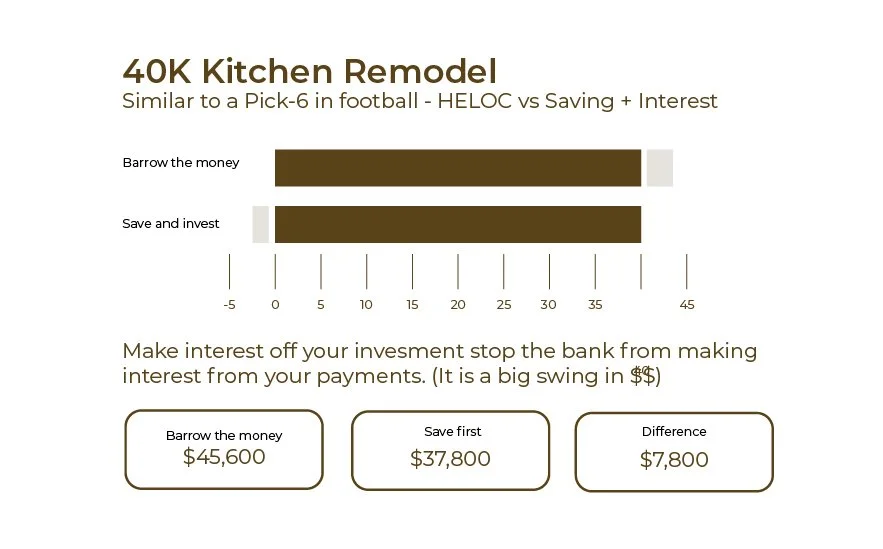
Here is the question worth asking: what if you took that same monthly payment and sent it somewhere else first. A Standard and Poor's 500 index fund (a fund that automatically holds stock in the five hundred largest publicly traded companies in America, spreading your money across the whole market rather than picking individual winners) has historically returned around 10 percent annually over the long term, though any two to three year window can go either direction. VOO, the Vanguard S&P 500 ETF, is one of the most widely held versions with a management fee of just three dollars per ten thousand invested. A high yield savings account or money market fund is currently paying around 4 to 4.5 percent with no risk and no lock-in. Put $1,250 a month into either one for three years and you end up with enough to pay cash for the kitchen. You own it outright, there is no lien on your home, and the position you built keeps compounding after the tile is grouted.
This is not investment advice. Talk to a financial advisor about what makes sense for your situation. But the concept is simple: money parked with intention, even conservatively, beats money spent on interest.
Some financial advisors would tell you to do exactly this. They would also tell you to drive a beater until you can pay cash for a car, and that one works better in theory than in most driveways. The honest version is that the pay yourself approach requires something the loan does not: three years of discipline while you live with the kitchen you have. That is a real cost. If the kitchen genuinely affects daily life, if it is the thing one person has wanted for a decade, if you are going to sell in four years and recoup most of it anyway, the life math still applies. But if the kitchen works fine and this is purely about wanting something nicer, paying yourself first is the most financially sound path available. You get the same kitchen, you pay no interest, and you build a habit that extends well past the renovation. The question is honest: can you actually do it. Not whether you intend to. Whether the money will still be going into that account in month fourteen when the car needs work and the vacation came up and the kitchen still looks the same. If the answer is yes, pay yourself. If the answer is probably not, the loan at least gets the work done and the life math still holds.
WHAT ABOUT YOUR CREDIT SCORE
Dave Ramsey calls it the "I love debt score." If you have more cash than you know what to do with, he has a point. The score measures how well you manage borrowed money, not how wealthy you are or how disciplined your finances are. A person sitting on a million dollars in savings with no debt can have no credit score at all.
But most people are not in that position. And for everyone else, that three-digit number has real consequences. It determines whether you qualify for a mortgage, what interest rate you pay, whether a landlord approves your application, and sometimes whether an employer takes you seriously. A beat-up score costs money every time you borrow. A strong score saves it. Here is what most people do not know about a HELOC: opening one and using it responsibly can actually improve your score. The hard inquiry at opening creates a small temporary dip. But a credit line sitting open and unused lowers your overall utilization ratio, which the scoring models reward. Draw it for the repair, pay it back within a year, and you have demonstrated exactly the behavior that improves a score. People who treat a HELOC like a tool rather than a windfall often come out with better credit than they started with. The people carrying damaged credit have even more reason to think about this carefully. Used with intention and paid back aggressively, a HELOC can be part of rebuilding. Carried indefinitely at minimum payments, it quietly makes things worse.
HOW TO THINK CLEARLY BEFORE YOU CALL THE BANK BACK
Start with what the money is actually for before you think about whether you can get it. Active damage or deferred maintenance: borrow, fix it, pay it back fast. Set a twelve to twenty-four month payoff target before you sign anything. The product is useful. The thirty year version of it is expensive. A renovation you have genuinely wanted and will genuinely use: run the honest numbers including the years you will live with the result. The life math is real even if a spreadsheet will not show it. Enough discipline to pay yourself first: do it. Park the money somewhere it earns something instead of somewhere it costs something. The kitchen will still be there in three years and you will own it free and clear.
And when the next mailer arrives, understand something clearly. The bank is not calling because they want you to make the best decision for your family. A lender does not feel bad about the interest you paid any more than a casino feels bad about last Saturday night. The product exists because it is profitable. None of that makes it wrong for you. It just means you are the one who has to do the thinking.
“Do the thinking."
Marc Bostian is a real estate agent with Windermere Snohomish and a property manager with R Squared Properties. He writes about buying, selling, and owning property at MarcBostian.com. Call or text: 425.492.6788